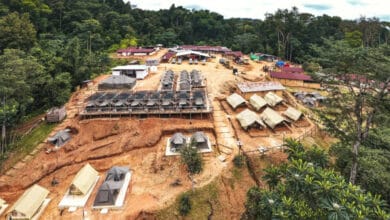
Kameelburg project delivers 603 metres of continuous mineralisation

The Kameelburg project has delivered 603 metres of continuous mineralisation averaging about 2.4% strontium carbonate (SrCO₃), with peak grades reaching 6.86%, as Aldoro Resources confirms the emergence of significant strontium alongside rare earth elements and niobium.
Results from the company’s Phase II drilling programme show that mineralisation at Kameelburg is extending both laterally and at depth, with diamond drill hole DD005E intersecting more than 600 metres of continuous mineralisation.
The same drilling has identified a previously unrecognised mineralised layer enriched in strontium, rare-earth elements, and niobium, signalling a shift in how the deposit is understood.

Assays indicate strong strontium grades throughout the system, with shallow intercepts returning up to 6.86% strontium carbonate (SrCO₃) and multiple zones consistently reporting grades between 4% and 6% SrCO₃.
Across the full 603-metre interval, the mineralisation averages about 2.4% SrCO₃, underscoring both scale and continuity.
The results place strontium alongside rare-earth elements and niobium as a potentially significant component of the Kameelburg system, rather than a secondary or incidental mineral.
Aldoro’s data further show a strong correlation between rare-earth mineralisation and strontium, with a correlation coefficient of 0.92, suggesting the two occur together within the same geological system.
This relationship could prove important for processing, as multiple saleable products may be recovered from the same ore stream.
The emergence of strontium comes amid tightening global supply. Prices for strontium carbonate have surged by around 100% over the past year, rising from roughly US$1,200 per tonne to about US$2,400 per tonne, driven by supply disruptions and geopolitical pressures.
Global supply remains highly concentrated, with Iran estimated to control about 85% of celestite reserves, the primary source of strontium, while China relies heavily on imports for its industrial needs.
This concentration has elevated strontium’s strategic importance, particularly as demand grows in sectors such as electric vehicles, renewable energy and electronics.
Strontium carbonate is a key input in the production of ferrite magnets used in EV motors, wind turbines, and consumer electronics, accounting for 25%-40% of material costs. Its role in these technologies has led to its classification as a critical raw material by both the United States and the European Union.
At Kameelburg, the addition of strontium to the mineralisation profile could enhance project economics. Aldoro noted that the presence of multiple valuable elements within the same system could help offset processing costs by increasing the basket of recoverable products.
The broader drilling programme continues to expand the known footprint of the deposit, which now extends approximately 1.5 kilometres in length, 650 metres in width and at least 600 metres in depth, with mineralisation remaining open.
With further assays pending and an updated mineral resource estimate expected, the project is increasingly being defined as a large-scale, vertically extensive system containing a combination of rare earth elements, niobium and now strontium.