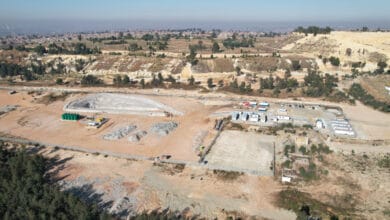
Ivanhoe Mines announced that the first copper anodes were produced by Kamoa-Kakula’s on-site, state-of-the-art 500,000-tonne-per-annum direct-to-blister copper smelter on 29th December 2025, approximately five weeks after the commencement of the smelter’s heat-up and one week after the first feed of concentrate.
Ivanhoe Mines’ Founder and Executive Co-Chairman Robert Friedland commented:
“The first production of copper anodes from our world-class smelter is a defining moment for Kamoa-Kakula. This achievement is the culmination of a US$1.1 billion investment, 18 million man-hours of disciplined execution, and an outstanding health and safety record that reflects the professionalism and commitment of everyone involved.

“This facility will proudly deliver the highest-quality Congolese copper anodes to the international markets, setting a new global benchmark for scale, efficiency, and sustainability. I want to extend my sincere thanks to the extraordinary Kamoa Copper team, as well as our contractors and partners from across the world whose expertise, innovation, and teamwork made the design and delivery of this state-of-the-art facility possible. Together, we have built something exceptional that will serve global consumers for generations to come.”
Smelter ramp-up underway to achieve a steady-state annualised rate of 500,000 tonnes of 99.7%-pure copper anode, making it the largest copper smelter in Africa
The ramp-up of the Kamoa-Kakula copper smelter will continue throughout 2026, with completion expected towards year-end. As announced on 3rd December 2025, Kamoa-Kakula’s copper production is estimated at between 380,000 and 420,000 tonnes of copper in 2026, with the mid-point of 400,000 tonnes of copper representing approximately 80% of the smelter’s total capacity.
Kamoa-Kakula’s management team will prioritise the processing of concentrates produced by the Phase 1, 2, and 3 concentrators through the on-site smelter, with any excess concentrate toll-treated at the Lualaba Copper Smelter (LCS), near Kolwezi, in the Democratic Republic of the Congo (DRC).
Heat-up and completion of hot commissioning of the smelter furnace, as well as boiler, steam systems, acid circuit and the concentrate dryer were completed in line with expectations. The furnace successfully reached its operating temperature of 1,250 degrees centigrade (2,282 degrees Fahrenheit) for five days prior to the first feed of concentrate.
Prior to the first feed of concentrate into the smelter, Kamoa-Kakula’s on-site concentrate inventory contained approximately 37,000 tonnes of copper. Total unsold copper in concentrate at the smelter, held in stockpiles and the smelting circuit, is expected to be reduced to approximately 17,000 tonnes during 2026 as the smelter ramps up. Therefore, 2026 copper sales are expected to be approximately 20,000 tonnes higher than copper production as the on-site inventory of unsold copper concentrate is destocked, predominantly during H1 2026. As destocking occurs, Kamoa-Kakula’s management aims to capitalize on near-record-high copper prices.
The installation of the uninterruptible power supply (UPS) facility was completed prior to the first feed of concentrate into the smelter, which took place on December 21, 2025. The 60-megawatt (MW) UPS is designed to provide up to two hours of instantaneous back-up power to the smelter, protecting the operation from voltage fluctuations in the domestic DRC grid. In addition, construction of Kamoa-Kakula’s 60 MW on-site solar (PV) facilities continues to progress well. The solar site, with battery storage, is expected to be the largest of its kind in Sub-Saharan Africa. The solar facilities are expected to be operational from Q2 2026, providing 24 hours a day of uninterruptible power, in addition to the approximately 180 MW of on-site diesel-powered, back-up generator capacity already in place.
Kamoa-Kakula’s operating margins are set to expand due to reduced logistics costs from the smelter, as well as sales of by-product sulphuric acid
Kamoa-Kakula’s margins are expected to expand as the smelter ramps up, as concentrates produced by Phase 1, 2, and 3 concentrators are smelted on-site, rather than being exported unbeneficiated. Kamoa-Kakula’s logistics costs are expected to approximately halve as the copper content per truck-load exported more than doubles, from approximately 45% contained copper in concentrate to 99.7%-pure copper anodes. Further savings are expected to be also achieved through the significant revenues generated from sulphuric acid sales.
In addition to the first production of copper anodes, the Kamoa-Kakula smelter also produced its first batch of by-product sulphuric acid. The smelter is expected to produce up to 700,000 tonnes per annum of high-strength sulphuric acid at steady-state operations, which will be sold locally.
Sulphuric acid is in high demand by other mining operations across the Central African Copperbelt, especially following the export ban of acid by Zambia in September 2025. Spot acid prices have reached as high as US$700 per tonne in Kolwezi in recent months. The first sale of acid by Kamoa-Kakula has already taken place, with the first delivery expected in the coming weeks.
Construction of copper smelter delivered with industry-leading health and safety record
Kamoa-Kakula’s projects team extended their industry-leading health and safety record during the construction of the smelter. During the 18 million hours worked, only one lost time injury (LTI) was recorded, an exceptionally rare industry achievement. Therefore, the lost-time injury frequency rate (LTIFR) for the delivery of the smelter was approximately 0.054 per million hours worked.
The last project delivered by Kamoa-Kakula’s project team was the Phase 3 concentrator, which was completed in mid-2024 without a single LTI recorded.
Stage Two dewatering of Kakula Mine complete; selective mining on the eastern side commenced ahead of schedule in late December
Stage Two dewatering activities are complete, with the first pair of high-capacity submersible dewatering pumps (Pumps 3 and 4) running dry. As announced on 3rd December 2025, following an underground survey, Pumps 3 and 4 were repositioned lower in late November to enable an additional Stage Two dewatering. Since then, the water level has declined by a further 19 metres to the level shown in Figure 1. The second pair of Stage Two pumps (Pumps 1 and 2), which are approximately 20 metres lower in elevation compared with Pumps 3 and 4 are expected to run dry in January 2026.
Stage Three dewatering activities will take over from Stage Two dewatering, and consist of re-commissioning the existing, water-damaged underground horizontal pump stations, which are used for steady-state operations. The rehabilitation work consists of fitting new pump motors, substations and electrical cabling. All required equipment is on site, and installation will begin once access to the horizontal pump stations becomes available.
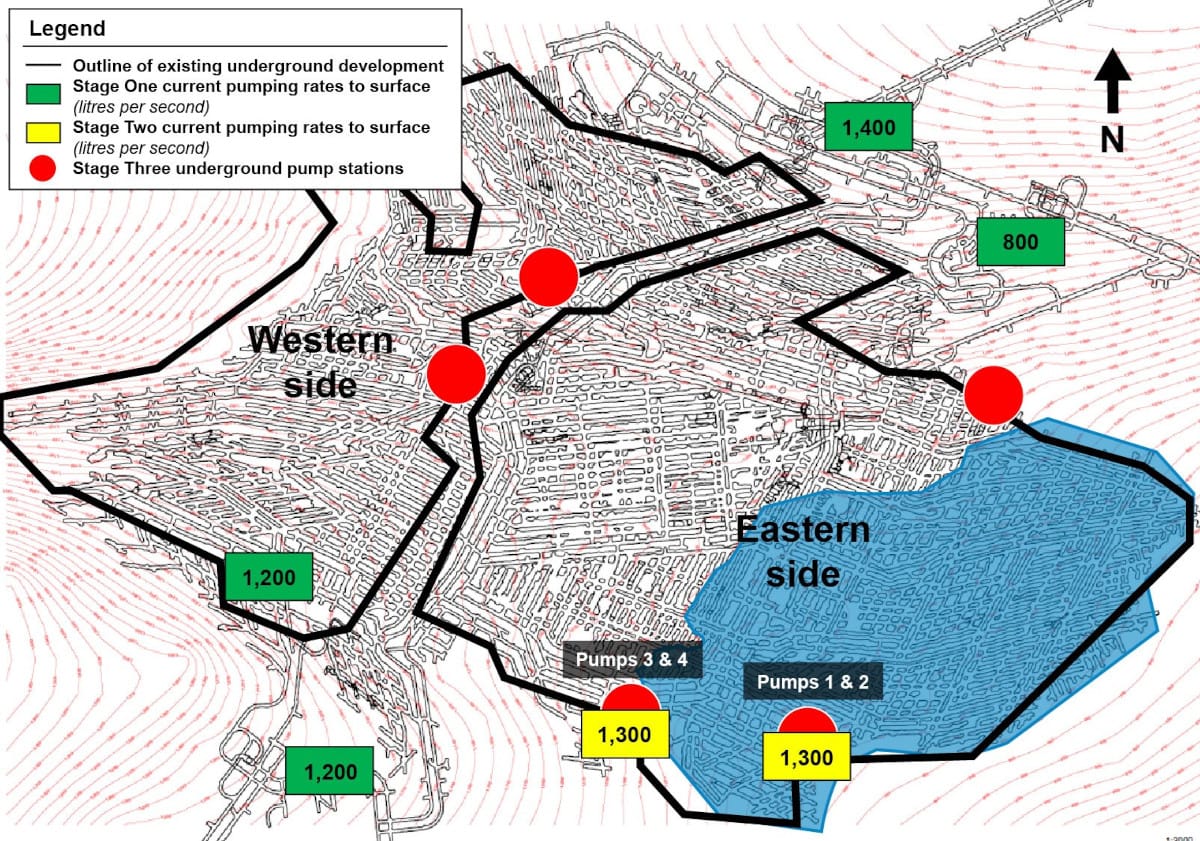
There is currently 5,600 litres per second of installed pumping capacity at the Kakula Mine, excluding the Stage Two pumping infrastructure. Stage Three dewatering activities are expected to continue into Q2 2026 and will not be on the critical path for Kakula’s mining operations.
In addition, the western side of the Kakula Mine has been dewatered, enabling the mining of higher-grade areas. Head grades from mining areas on the western side of Kakula are expected to increase from 3.5% copper in January to approximately 4.0% copper by the end of Q1 2026. In addition, selective mining on the eastern side of the Kakula Mine began ahead of schedule at the end of December.