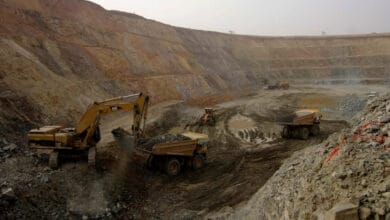
The Otjikoto Gold Mine delivered one of its strongest production years on record in 2025, producing 199,139 ounces of gold and generating US$685 million approximately N$13.02 billion in revenue as prices surged and output landed near the top of guidance.
The mine, in which B2Gold Corp holds a 90% interest, converted production scale and metallurgical efficiency into strong cash generation during its final year of open-pit mining.
Average realised gold prices reached US$3,449 per ounce (about N$65,531/oz) for the year, rising sharply to US$4,175 per ounce (around N$79,325/oz) in the fourth quarter, amplifying the revenue impact of each ounce produced.

Production momentum was most visible in the final quarter, when Otjikoto produced 50,793 ounces, significantly above expectations.
The outperformance was driven by the continued processing of high-grade open-pit stockpiles after mining activities in the pit ended at the beginning of the quarter.
For the full year, the operation processed 3.44 million tonnes of ore at an average grade of 1.83 g/t and maintained an average gold recovery of 98.7%, underscoring the mine’s operational stability and processing efficiency.
Cash operating costs for 2025 averaged US$658 per ounce produced (approximately N$12,502/oz) and US$656 per ounce sold (around N$12,464/oz), below the midpoint of guidance.
All-in sustaining costs were held to US$969 per ounce sold (about N$18,411/oz), at the low end of the guided range. Lower-than-budgeted sustaining capital expenditure further strengthened cash flow during the year.
Capital expenditure at Otjikoto totalled US$24 million (roughly N$456 million) in 2025, focused mainly on underground development at Wolfshag, expansion of the tailings storage facility, early development work at the Antelope deposit and mobile equipment rebuilds.
Sustaining capital spending came in about US$8 million (approximately N$152 million) below budget, largely due to slower-than-planned underground development, reinforcing the mine’s cash contribution in a high-price environment.
With open-pit mining completed late in the year, attention has shifted to the underground growth pipeline. In September 2025, B2Gold approved the development of the Antelope underground deposit following optimisation work that reduced estimated pre-production capital costs from US$129 million (about N$2.45 billion) to approximately US$105 million (around N$1.99 billion).
The preliminary economic assessment outlines an initial five-year mine life producing roughly 327,000 ounces, with Antelope expected to lift Otjikoto’s annual production to around 110,000 ounces between 2029 and 2032 when combined with stockpile processing, subject to the uncertainties associated with inferred mineral resources.
Gold production at Otjikoto is expected to moderate in 2026 to between 70,000 and 90,000 ounces as the operation transitions fully to underground mining at Wolfshag, supplemented by existing low-grade stockpiles.
Capital expenditure is forecast to rise to about US$57 million (approximately N$1.08 billion) in 2026, reflecting increased underground development and progress on the Antelope project, as the mine reshapes itself from an open-pit operation into a longer-life underground producer within Namibia’s gold sector.