Madison Metals acquires one of Canada’s largest undeveloped antimony deposits in a Hemlo Gold Camp setting

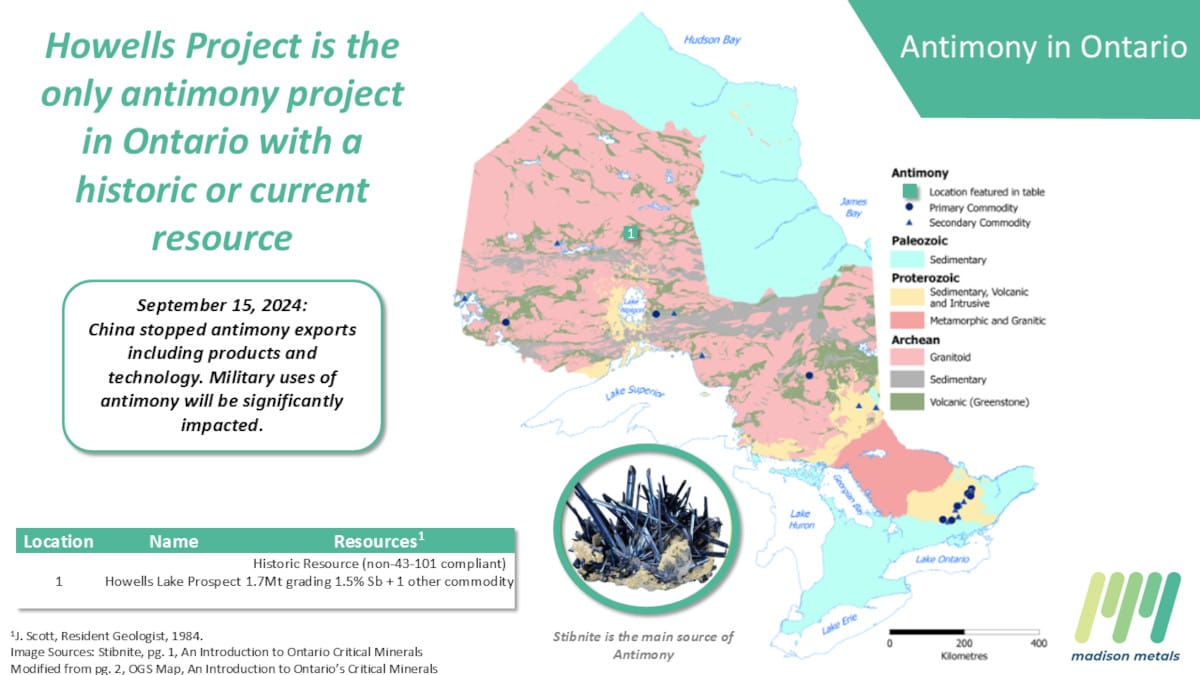
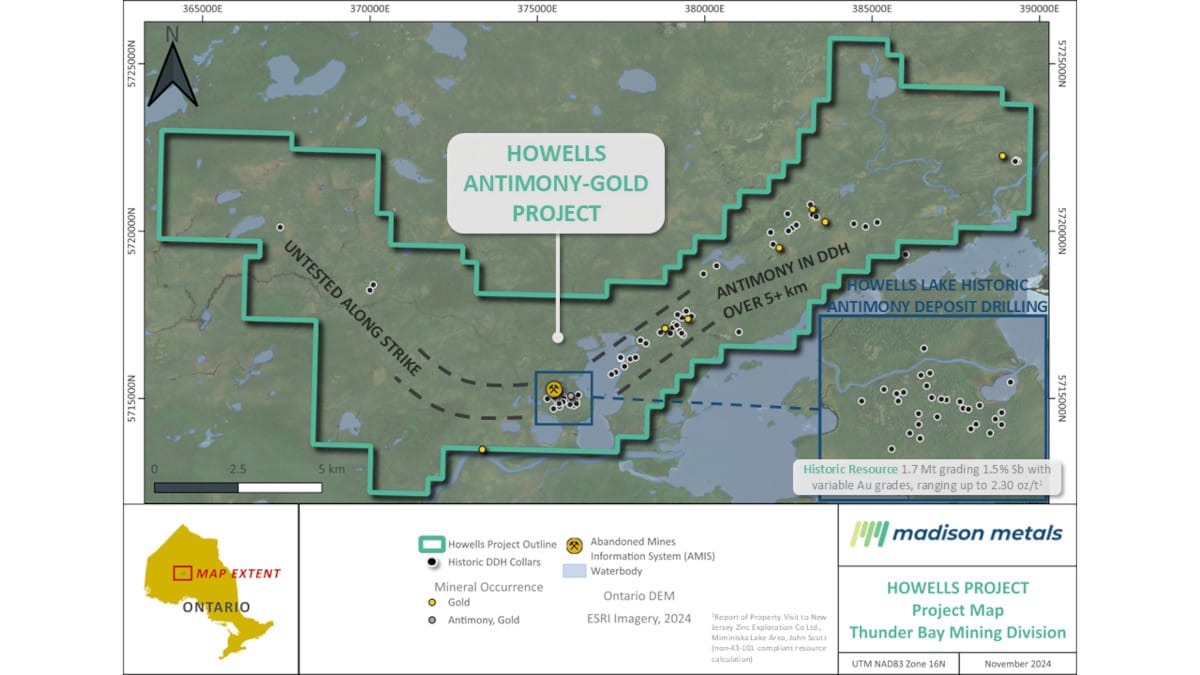
Madison Metals Inc. is pleased to announce it has significantly increased its presence in the critical minerals sector by signing binding letters of intent with three separate entities to acquire 100% interest in a large, belt-scale antimony-gold project covering 13,990.90 hectares over 697 claims. The Howells Lake Antimony Gold Project is located in the Howells Lake area in the Thunder Bay Mining Division of Ontario, Canada. Antimony, for which the price has tripled in the past year, is right now arguably one of the most attractive critical minerals in the world, and the Howells Lake Project provides Madison with one of only a handful of antimony historic resources.
“Micro-cap companies rarely, if ever, have the opportunity to obtain complete control of a large, belt-scale asset like the Howells Lake Project, covering such an extensive area of known mineralization that seems to have been overlooked for decades,” said Duane Parnham, Chairman and CEO of Madison Metals. “The Howells Lake Project has enormous potential to have real economic significance, and Madison is seizing this rare opportunity to discover new areas of antimony-gold mineralization as well as define the known areas of antimony and gold mineralization on this very large, underexplored land position. We believe we can drive real shareholder value creation as soon as we get exploration underway on the project.”
Howels Lake highlights
- High-grade antimony was first reported at the Howells Lake Project in the 1940s as mineralization in boulders, and first discovered in drill holes some two kilometres (km) away in the mid-1970s.
- A non-NI 43-101 compliant historic resource estimate for the Howells Lake Project was reported by John Scott, Ontario Resident Geologist – 1,700,000 tons at 1.70% antimony* (*see disclosure below). This tonnage would be equal to approximately 51 million pounds of contained antimony.
- Mineralization is located from the surface to about 150 metres (m) depth.
- Mineralization remains open to further expansion both laterally and to depth.
- Mineralization is related to strong deformation, carbonate alteration, green mica, sericite and quartz veining, intrusive rock units, pyrite and pyrrhotite, as well as minor base metal mineralization.
- Gold mineralization associated with the antimony mineralization is reported to be up to 2.3 ounces per ton, although the average gold content is not available for the historic antimony resource tonnage.
- At least CDN$2 million was spent in the early exploration phase in the 1970s-1980s by just one of the companies.
- No significant drilling or other comprehensive work has been completed in the vicinity of the antimony deposit in the past 40 years.
- The property covers 20 km of favourable geology with little drilling outside the resource area.
- Stibnite (antimony mineral) was reported in drill holes over 5,000 m along trend and remains open for expansion and fill-in work.
The historic mineral resource was prepared before the implementation of NI-43-101 standards for disclosure for Mineral Projects. The historic resource does not meet the disclosure required under the provisions of NI-43-101 and should not be relied upon. The report was prepared by New Jersey Zinc staff in 1977 and reported on by then Ontario Resident Geologist John Scott. While the resources should not be relied upon, the QP for this release considers the resource estimate to be pertinent and of value for readers to consider.

“Antimony was historically discovered in drilling alongside gold mineralization on the Howells Lake Project in the early 1970s,” said Parnham. “The antimony price run-up has been driven by its supply-demand fundamentals, and its tripling in price over the past year has been largely sparked by increasing demand and the Chinese export restrictions that took effect September 15, 2024. Expanding our portfolio to include this high-impact, high-grade project complements our existing uranium assets and positions us as a first mover in the space.”
Parnham continues, “In addition to the antimony potential, the Howells Lake Project is very similar in its geochemistry and geological setting to that found in the world-class Hemlo gold deposits, where gold production and resources now exceed 25 million ounces. Many setting similarities make the Howells Lake Project a very rare ‘Hemlo copy.’ They include the presence of antimony, quartz sericite alteration, green mica, felsic dikes, evidence of regional faults and unconformities with the unique addition of the presence of high-grade antimony associated with some of the gold mineralization, which was largely overlooked or thought to have little value given the antimony price of the 1970s, which was a fraction of the current pricing. Millions were spent exploring the area and defining mineralization, and this work produced a substantial non-43-101 compliant historical resource* of approximately 51 million pounds of antimony, along with gold mineralization. With gold prices soaring past US$2,600 per ounce and antimony trading at more than $16 per pound, the combination amplifies the project’s economic potential.”
Madison also wishes to welcome Mr. Bruce Durham to our team as special technical advisor to the Board of Directors and lead technical manager of all activities at the Howells Lake Project.
Antimony is a critical mineral that is vital for numerous applications. In defence applications, it is becoming increasingly strategic and growing in use for military applications, such as hardening bullets, reinforcing shell casings, and enhancing high-tech military screens, among other uses. It is also used in semiconductor manufacturing and is a key ingredient in fire retardants and solar panel manufacturing.
Global antimony supply faces significant challenges. China produced 48% of the world’s supply in 2023 but essentially ceased exports on September 15, 2024, causing a severe shortage and resulting in a tripling of prices in the past year. With virtually no Western production and no new major projects under development, the need for new mines and refining capacity is urgent.
Antimony is on the critical metals list of Canada, the United States, and the European Union. In Canada, projects that qualify as critical minerals projects can receive funding incentives not available for other exploration projects.