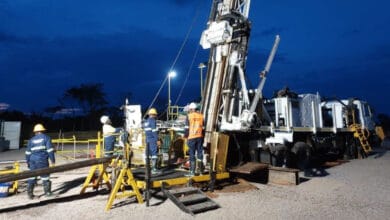
I recently read a short story by a colleague and the Africans for Africa Mining Fund Manager, Mr. Janade Du Plessis, called The Silver Shadow. One character’s journey stayed with me. Youssef, a silver miner. A 34-year-old father of three who descends 800 metres into Morocco’s Anti-Atlas Mountains every morning mining silver. Youssef works for a large mining company. He has a contract and a decent wage. Youssef operates within the formal system.
But for every Youssef with a formal contract, there are ten thousand Marys, Johns, Aminus, and Fortunes without one yet their work schedules are not so dissimilar.
Mary wakes before dawn somewhere in the DRC, Ghana, Zimbabwe, or Mali. She walks to a site, mines whatever the earth gives her that day, and by evening she sells it an aggregator. The aggregator arrives with a scale, a price she did not negotiate, and cash she cannot afford to refuse. He sells upward and eventually gets exported often not via official means. The mineral moves. The value disappears.

Mary’s path out of informality does not run through a multinational mining company. It runs through her neighbour, Emmanuel.
Emmanuel runs a small-scale mining operation in the same region. He employs twelve people, holds a local mining licence, and has spent three years trying to access formal export markets. He knows the land, the geology, and critically he knows Mary. He has the relationships, the local infrastructure, and the operational capacity to bring them together into a regional cooperative: to give them shared equipment, collective bargaining power, and a single documented production record that a formal buyer could trace and verify.
Emmanuel is the bridge between Mary’s invisible labour and the formal supply chain. The small-to-medium operator who can organise informal artisanal miners into compliant, traceable, bankable cooperatives at a regional scale. The formalisation layer.
But Emmanuel cannot afford the compliance paywall either.
In a previous piece, I highlighted the relentless export of unprocessed natural resources and the structural outflow of financial capital. Once again, Africa does not have a resource problem; it has a resource management problem. But before we can solve that management crisis, we must address the gatekeeper standing at the door: the global compliance architecture that shuts out not just Mary, but the very operators who would formalise her. This is the compliance paywall.
The Aggregator
It is tempting to view the aggregator as the villain in Mary and Emmanuel’s story. He is not. He is merely the first rational actor in an irrational system.
Both have no formal identity in the supply chain. Now consider Emmanuel specifically. Unlike Mary, he has a licence. He has an operation. He has the structure in place to absorb Mary and others like her into a formal cooperative to become the compliance anchor for an entire cluster of artisanal miners in his region. But to access the global buyers directly who would reward that formalisation, Emmanuel needs to pass the same ESG audit that a multinational mining company faces. A third-party compliance audit for a small mining operation could cost between US$50,000 to US$100,000. Emmanuel’s entire annual operating margin may not exceed that figure (considering he is not able to sell at fair market prices). So, he cannot certify. And because he cannot certify, he cannot formalise the artisans who depend on him. And because they remain informal, the aggregator remains the only buyer in the room.
This is how the compliance paywall compounds. It does not just exclude individual artisanal miners it excludes the small-scale operators who are the natural and most efficient vehicle for bringing those miners into the formal economy at scale. A single Emmanuel, properly supported, could formalise fifty Marys.
The paradox of good intentions
The issue is not the necessity of Environmental, Social, and Governance (ESG) standards. They are essential for a sustainable future. The problem lies entirely in their design.
Most global frameworks, for instance the OECD Due Diligence Guidance, functions in practice as though it were engineered for multinational corporations with dedicated compliance teams and budgets to match. They were not designed around the question: what does a small-scale mining operator with twelve employees and a local licence need to access a formal, priced market and in doing so, bring the informal miners in his region with him?!
The result is a system that produces the precise opposite of its stated intention. When formal compliance is not accessible, small operators do not close down. They survive in the grey zone selling to the same aggregators, accepting the same discounts, leaving the Marys on their periphery unorganised and invisible. The cooperatives that could exist do not get built. The regional clusters that could anchor an entire local economy remain fragmented. And the very conditions these frameworks claim to prevent (exploitation, environmental damage and supply chain risk) find the most room to grow precisely in the gap between what the system demands and what it has made accessible.
ESG frameworks were designed on the silent assumption that operators who cannot meet the standard will either scale up or step aside. Emmanuel disproves that assumption every day he stays in business. He does not scale up because the capital to do so is not available at a rate he can service. He simply operates below the compliance line, invisible to the formal market, carrying with him all the others he could have formalised if the system had made room for him.
The African standard
The pushback against African-contextualised standards often comes wrapped in a reasonable-sounding concern: that “local” inevitably means “lower.” Let’s disprove this logic.
Even the world’s most successful global consumer brands understand that efficacy requires adaptation. Coca-Cola and Fanta quietly adjust their formulas between markets to reflect local realities. Neighbouring countries like France and Spain have different formulas and this is not a regulation demand as both are in the EU. We accept, without controversy, that a soft drink needs local calibration to work properly (with my preference being the Spanish formula). Why do we insist that something as fundamental as mining linked to so many livelihoods must follow a rigid playbook written without the local and regional nuances it requires?
The Africa Mineral Development Centre (AMDC) has provided precisely that solution through the African Mineral and Energy Resource Classification (AMREC) and the Pan-African Reporting Code (PARC). They are more rigorous in the ways that matter most for Africa, centring community equity, local security, and the governance realities on the ground, because they were designed by people who understand what those grounds look like. A framework written with the likes of Emmanuel at the forefront of the mind looks fundamentally different from one written without him.
It accounts for cooperative structures, regional cluster reporting, and the graduated compliance journey that turns an informal artisanal miner into a documented participant in a traceable supply chain. That difference is not a weakness. It is the entire point.
The Global market
Here is the argument that critics will correctly raise, and that we must answer honestly: what good is an African standard if European and American original equipment manufacturers do not formally recognise it?
This is the right question. And the answer lies in understanding the current moment with clear eyes.
The global energy transition has a material cost. And that materials cost is increasingly denominated in African minerals: cobalt from the DRC, lithium from Zimbabwe, coltan from Central Africa, graphite from Mozambique. Africa holds approximately 30% of the world’s critical mineral reserves, and the world’s appetite for those minerals is growing faster than new supply can be unlocked.
The path forward is specific: African governments, the Africa Minerals Strategy Group, the Global South Council on Critical Minerals, and the African Union must advocate and negotiate formal recognition of AMREC and PARC within the EU Critical Raw Materials Act and the supply chain provisions of existing trade agreements with global partners. This is achievable because the precedent already exists. Market access has always shaped standards adoption faster than moral persuasion ever has. When the alternative is losing access to African supply, OEMs adapt. The energy transition gives Africa the standing to insist on exactly that.
Why the solution is achievable now
For the first time in a generation, the forces necessary to move from policy aspiration to operational reality are converging.
Political will has shifted from rhetoric to institution-building. For instance, the African Union is establishing the African Credit Rating Agency as instruments of continental financial sovereignty (a necessary win for financial sovereignty that deserves its own piece later). The 2025 G20 Declaration explicitly acknowledged that critical minerals must catalyse broad-based development rather than raw material exports alone.
Private sector energy is building behind this shift. At Africans for Africa (AFA), we are providing the necessary liquidity to build compliant, transparent supply chains. Our inaugural project, a gold tailings processing operation in Ghana, is already doing what this piece argues for: pooling domestic capital, partnering with indigenous operators, and ensuring the financial upside circulates within the formal local economy rather than flowing outward illicitly. We are going further via the initiative to set the benchmark on capacity building and assisting in developing the frameworks with the local nuances. The goal is not just to invest in Africa’s minerals, we aim to build the architecture that makes those investments permanently beneficial to the communities that produce them.
And then there is technology. For decades, tracking millions of artisanal miners across remote terrain was a logistical impossibility that made compliance frameworks impractical by design. That excuse no longer holds. Africa now has over 600 million mobile subscribers. Traceability and tokenisation technology, once prohibitively expensive to deploy at scale, can now create an immutable, real-time record of a mineral’s journey from pit to port at a fraction of the previous cost. Earlier traceability pilots in the DRC and Rwanda struggled with connectivity gaps and adoption costs both of which the current mobile infrastructure and reduced hardware costs have substantially addressed.
Critically, this technology does not simply satisfy distant OEMs. It solves the aggregator problem at source. When Mary’s production has a verifiable on-chain identity from the moment she extracts it, the aggregator’s information advantage and the margin he extracts for holding it begins to collapse. Transparency baked directly into the mineral removes the compliance tax from both ends of the chain simultaneously.
Conclusion
My previous piece highlighted that when capital exists to back local beneficiation, the economics of African mining change fundamentally. Uganda’s tin refinery and Nigeria’s lithium processing plant did not require permission from the global financial system. They required capital and the will to deploy it.
The same logic applies here. Formalisation will not happen because the world’s compliance frameworks become more generous. It will happen because we build the bridge ourselves and measure our success not by what leaves, but by what stays.
Until this is built, illicit flows will continue. The mineral moves upward through a chain that grows more valuable at every step, yet none of that value is captured by the communities where it is mined.
The compliance paywall is not insurmountable. But it will not fall on its own. We must build the bridge over it.