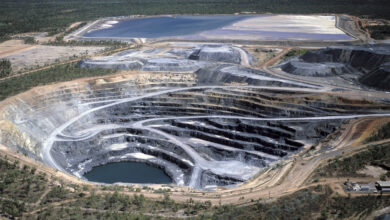
Atomic Eagle has announced the results of the metallurgical test work program conducted on drill core collected from the recently discovered Muntanga East uranium deposit, part of the Company’s 100%-owned Muntanga Uranium Project in Zambia.
Atomic Eagle CEO Phil Hoskins said:
“One of the defining strengths of the Muntanga Project is its ability to achieve high uranium recoveries through simple heap leach processing with low reagent consumption. This allows lower grade uranium mineralisation to be mined and recovered economically.

This strong metallurgical performance has now been replicated by test work on the newly discovered Muntanga East deposit and on lower-grade mineralisation than has historically been evaluated elsewhere across the Project.
The combination of Muntanga East’s shallow mineralisation, close proximity to the central resource area and favourable metallurgy provides confidence it will contribute towards enhancing the scale and economics of the Muntanga Project.”
Metallurgical test work program
Metallurgical test work was conducted on two representative composite samples prepared from diamond drill core obtained specifically for metallurgical evaluation following the delineation of the Muntanga East Mineral Resource. The program, undertaken by Mintek in South Africa, was designed to evaluate uranium extraction performance, acid consumption characteristics and the physical suitability of the material for heap leach processing.
The material was crushed to a nominal top size of 25 mm and subjected to a comprehensive program including diagnostic leach testing, bottle roll leach testing, column leach testing and heap leach geotechnical assessments designed to evaluate the suitability of the mineralisation for heap leach processing. The average uranium head grade of the composites was approximately 167 ppm U3O8.
The results confirm that Muntanga East mineralisation is highly amenable to heap leaching, delivering uranium recoveries consistent with those achieved elsewhere across the Project while exhibiting exceptionally low acid consumption.
Importantly, the test work was undertaken on lower-grade mineralisation than has historically been tested from several of the Project’s other deposits, yet achieved uranium recoveries in line with previous programs.
Bottle roll leach results
Bottle roll leach testing achieved uranium recoveries of ~86% and ~82% after 25 days of leaching. Acid consumption remained low throughout the test period at approximately 3 kg/t. Uranium dissolution was effectively complete after approximately seven days, indicating rapid leaching kinetics and a high proportion of readily leachable uranium minerals.
The results indicate that approximately 80% of the uranium contained in the ore occurs in minerals that dissolve readily under conventional acid heap leach conditions.
Column leach results
Column leach testing was undertaken using 1-metre-high columns operating under conditions representative of heap leach processing. Both composites achieved uranium recoveries of ~81%, confirming strong extraction performance under dynamic leaching conditions.
Recovery profiles showed rapid uranium extraction during the early stages of leaching, with dissolution curves flattening after approximately 15 to 20 days. By this point, uranium recoveries had approached final extraction levels while acid consumption remained approximately 3 kg/t.
Although leaching continued for 62 days, only modest additional uranium recovery was achieved while total acid consumption increased to between 7.0 kg/t and 7.6 kg/t, demonstrating that the majority of uranium can be recovered with very low acid consumption.
Heap leach characteristics
The material exhibited excellent physical characteristics for heap leaching. Particle size analysis confirmed low fines content and minimal fines generation during leaching, reducing the risk of permeability loss.
Stacking assessments simulating a heap height of 6 metres demonstrated favourable bulk density and porosity characteristics while maintaining hydraulic conductivity of approximately 4,537 L/m2/h to 4,396 L/m2/h, more than four times the design threshold typically required for heap leaching operations.
The results confirm that Muntanga East mineralisation is amenable to conventional heap leach processing and displays physical characteristics consistent with efficient solution percolation and uranium extraction.