Madison Metals identifies high-grade uranium at Khan Project in Namibia

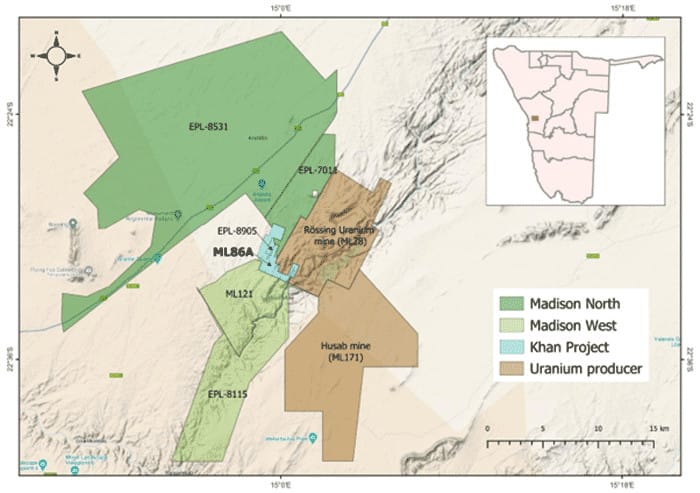
Madison Metals Inc. is pleased to provide an update on its recent exploration activities at the Company’s Khan Project at Madison West in Namibia’s highly prospective Erongo uranium province. The project consists of Mining Licence 86A (“ML86A”) and Exclusive Prospecting Licence 8905 (“EPL-8905”) and is immediately southwest of the producing Rössing Uranium Mine (Figure 1). Historically, detailed exploration for uranium has never been conducted at ML86A due to copper mining activities within the licence.
Madison exploration activities focused on the validation of untested airborne radiometric anomalies as well as understanding the geological setting and determining the continuity of mineralized alaskites. ML86A is underlain by favourable geology for Rössing-type deposits in the Central Namib where units of the Damara Supergroup are intruded by uranium-mineralized alaskites.
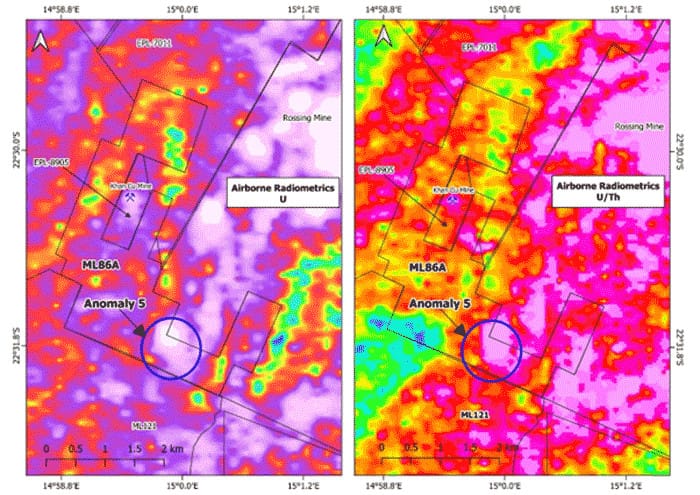
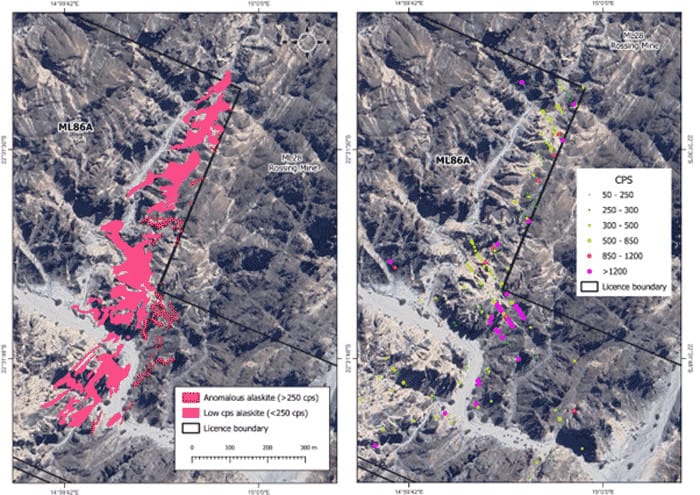
Based on the analysis of the airborne survey, several anomalies were detected adjacent to the Khan mine working and adits on EPL-8905. Follow-up field work indicated that these anomalies were mainly non-fertile SLG (Sheeted Leucogranite) commonly known as C type. Additional anomalies led Madison’s team to focus on the SE on Anomaly 5, where uranium-bearing D type SLG have been identified.

“The Khan Project is quickly becoming an extremely valuable asset to Madison, having huge potential for making new high-grade uranium discoveries sitting right next to two operating uranium mines,” said Duane Parnham, Executive Chairman and CEO of Madison Metals. “Madison has deployed field personnel to perform channel sampling and chemical analysis across favourable high-grade uranium rocks and expand the ground survey to other targets at ML86A in advance of a planned 2024 drilling program at Anomaly 5.”
Anomaly 5
Anomaly 5 is a prominent regional high-uranium and high-uranium/thorium (Th) anomaly occurring within a north-northeast-trending fold closure and located approximately eight kilometres (km) southwest of the Rössing Mine and seven km southwest of the Husab Mine pits.
Madison conducted a ground radiometric and geological mapping survey across Anomaly 5 at an initial line spacing of 80 metres (m) and station spacing of 10 m. This was later followed by a 40 m line spacing survey to determine the surface continuity of the target host units. The ground survey confirmed the existence of Damaran units of the Khan, Rössing, and Chuos formations which are intruded by a variety of post-tectonic intrusives including the radiometric anomalous alaskites. The alaskites occur as veins, dyke-like or anastomosing intrusions (Figure 3) predominantly in the Khan Formation and occasionally in the Rössing Formation. The alaskites have a surface thickness of up to seven metres and are characterized by smoky to black quartz and patchy secondary yellow uranium staining. Alaskite outcrops exhibit high U/Th ratio readings from the handheld spectrometer and sometimes carry intense radioactivity with total count values >15,000 counts per second (cps).
Due to the strong presence of uranium anomalies on the Khan Project, Madison is also pleased to announce the signing of an addendum agreement whereby cash payments made to date have secured an undivided 10% interest in the Khan Project. The balance aggregate payments due by December 31, 2024 will earn an undivided 90% interest.