Unicorn prepares to acquire a stake in historic Klein Aub Copper Mine

Unicorn Mineral Resources Plc is preparing to acquire a controlling stake in the historic Klein Aub Copper Mine after preliminary metallurgical test work returned copper recovery rates of up to 70% from historic slimes and up to 45% from tailings.
The company said the results were generated from early-stage metallurgical testing on material from the former Klein Aub operation in southern Namibia, where it is advancing plans to secure a 75% interest by April 2026.
The test work indicates recoveries of between 60% and 70% from slimes and 35% to 45% from tailings, encouraging further optimisation work.

Klein Aub ranks among Namibia’s older copper producers, with mining activity dating back to the 1960s.
The operation ran from 1966 until 1987, producing copper-silver ore that was transported for processing to the Tsumeb smelter.
Over its operating life, the mine produced an estimated 55,000 tonnes of contained copper from more than two million tonnes of ore before closing amid declining copper prices and rising operating costs.
After closure, underground workings were sealed, but substantial volumes of tailings and slimes were left on surface.
These materials have preserved a sizeable secondary resource that has increasingly attracted renewed interest as processing technologies and metals markets have evolved.
Unicorn said the metallurgy of the historic tailings and slimes is complex, largely due to high carbonate concentrations that make conventional acid leaching uneconomic.
In response, the company has been assessing alternative extraction methods and is working with Draslovka, a specialist in glycine-based leaching technology, to evaluate the potential for environmentally friendly copper extraction.
Further metallurgical work is now planned to optimise the reagent regime, improve recoveries and enhance the overall economic value of the copper that may be extracted.
The company also intends to investigate a dual leaching process to recover silver alongside copper, following a marked increase in silver prices in recent months.
Historic drilling and assay work completed since 2020 has outlined a potential non-JORC compliant inventory of approximately 5.59 million tonnes of material contained within the tailings and slimes dam at Klein Aub.
This material is estimated to host up to 15,460 tonnes of copper and around 1.4 million ounces of silver in situ. Unicorn noted that this estimate excludes several identified unmined parallel lodes extending along strike to the northeast of the former underground workings.
Encouraged by the initial metallurgical results, Unicorn said it has commenced work on the legal documentation required to complete the proposed transaction and remains on track to secure a 75% interest in the Klein Aub Copper Mine by April 2026.
Commenting on the results, chairman Paddy Doherty said the presence of metal at Klein Aub had been evident from early due diligence, but the main challenge had been identifying an economically viable extraction method.
“We are delighted to be now working with a team of experts in environmentally friendly glycine extraction technology from Draslovka, which looks to be the key to unlocking the value at Klein Aub,” Doherty said.
In a separate update, the company said it is also progressing the potential acquisition of additional Namibian copper assets located on two granted Exclusive Prospecting Licences covering a historic mine and associated tailings.
Site visits and independent technical reviews have identified further copper and silver mineralisation, with assay results from recent sampling expected later this quarter.
Unicorn said the majority and local shareholders of the Namibian assets have expressed an intention to complete the sale of a controlling interest to the company, subject to the completion of legal, technical and financial due diligence.
The board is advancing preliminary and non-binding negotiations, with a view to signing heads of terms in the near term.
Mining at Klein Aub began in 1966 and continued until 1987, making it one of central Namibia’s established copper mines of the latter 20th century.
During that period, the mine produced high-grade copper-silver ore, typically grading between 2% and 3% copper, with silver values reaching up to 60 grams per tonne.
Ore was trucked to the Tsumeb smelter, then operated by Tsumeb Corporation Ltd., which provided processing services and geological supervision.
The mine’s closure followed a combination of weakening copper prices and the withdrawal of supporting smelting capacity in the region, rendering continued underground operations uneconomic.
After abandonment, shafts were sealed and the settlement that had grown around the mine entered a long period of quiet, although a small local community persisted nearby and the tailings and slimes remained as a latent resource.
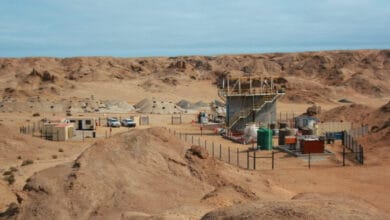
In the early 2000s, Namibian Copper Mines (Pty) Ltd. undertook limited rehabilitation and metallurgical testing at the site, constructing a small processing plant to assess reprocessing potential.
More recently, advances in extraction technology and improved metals markets have renewed interest in Klein Aub, prompting Unicorn to enter into conditional terms to acquire a 75% stake, with an initial focus on reprocessing tailings and slimes using environmentally friendly leaching techniques while evaluating the broader mineral potential of the area.